Fence lines, farm roads, and utility easements around Prentiss don’t stay open on their own — pine regrowth and privet close in fast on ground that isn’t worked every year. Circle B3 Mulching & Land Works is based in Jefferson Davis County and provides right-of-way clearing for landowners, farms, and utility easements throughout the area, using a drum mulcher that grinds brush and encroaching trees flush instead of just knocking them over. Whether it’s a driveway easement off US Highway 84 or a fence line that hasn’t seen a blade in years, we open it back up in a single pass and leave it walkable, not littered with debris. Call (601) 640-4095 for a free estimate on your right-of-way.
What Right-of-Way Clearing Actually Involves
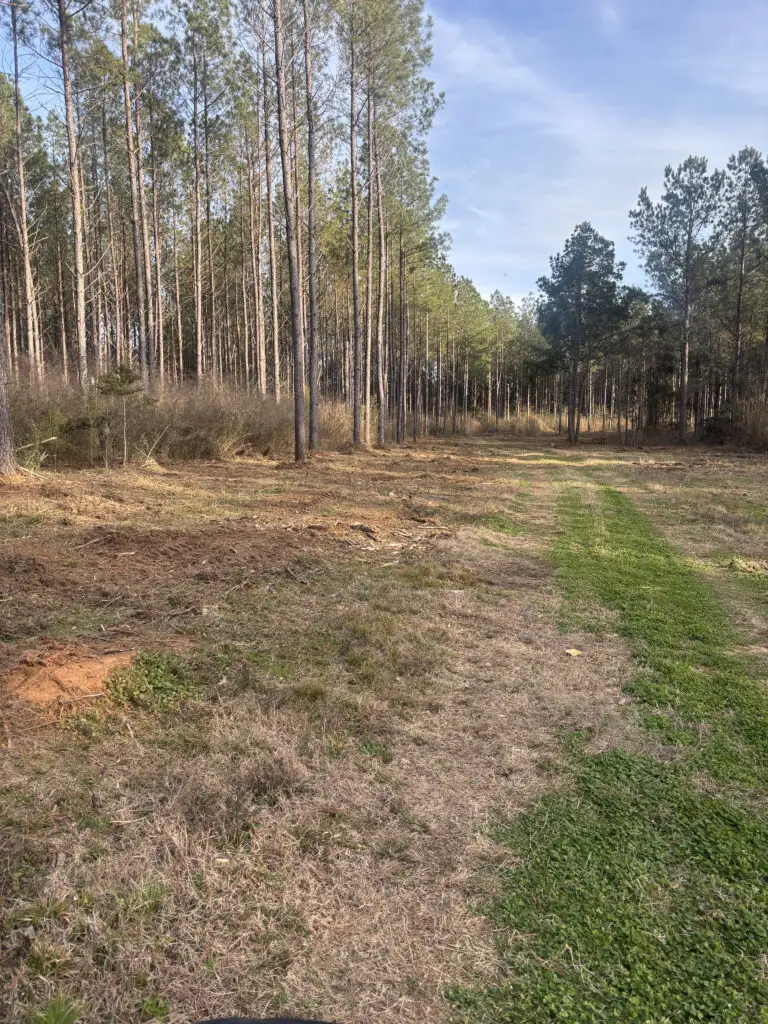
Right-of-way clearing opens and maintains a defined strip of land — a fence line, farm road, driveway easement, or utility corridor — by removing brush, saplings, and encroaching trees that have grown into the cleared width over time. Most rights-of-way in Lincoln County start the same way: a corridor that was clear when the fence or line went in has narrowed year over year as pine, sweetgum, and privet crowd back in from both sides, until what should be a clear strip is barely passable. Circle B3 runs the Kubota skid steer and drum mulcher down the length of the corridor, grinding vegetation flush to the ground on both edges and working around fence posts, gates, and existing structures without damaging them. Because the equipment mulches material in place rather than piling it for burning or hauling, there’s no debris left along the corridor to interfere with vehicle access, livestock movement, or line-of-sight — which matters for utility and farm-road rights-of-way where a clear sightline is often the whole point. The result is a corridor that’s clear edge to edge and stays that way longer, since mulched material breaks down instead of resprouting from a woodpile left behind.
Our Right-of-Way Clearing Process
Step 1 — Corridor Walkthrough and Estimate We walk the full length of the right-of-way with you — noting fence posts, gates, culverts, and any utility markers — and provide a flat-rate estimate based on the corridor’s length, width, and how overgrown it’s gotten. This on-site look is what lets us quote the job accurately instead of guessing at density from the road.
Step 2 — Edge and Obstacle Marking Before the mulcher moves in, we confirm the exact clearing width with you and flag anything that needs to be worked around — a well, a culvert, a property corner — so there’s no question about where the corridor starts and stops. This step matters most on shared or disputed boundary lines, where clearing the wrong few feet can create a headache with a neighbor.
Step 3 — Mulching Pass The skid steer and drum mulcher work the length of the corridor in a controlled pass, grinding brush and encroaching trees flush to the edges you marked. Because the machine can work close to fence lines and posts without the swing radius of a bulldozer or excavator, the corridor comes out clean without tearing out the fence itself.
Step 4 — Final Walkthrough We walk the finished right-of-way with you to confirm the full length is clear and the edges are where you expect them. You’re left with an open corridor and a mulch bed instead of a brush pile blocking the very access you just paid to clear.
Serving Prentiss and the Surrounding Area
From farm roads branching off US Highway 84 and Mississippi Highway 13 to utility and driveway easements scattered through Prentiss and the rest of Jefferson Davis County, Circle B3 clears rights-of-way close to home and on the same trips we make out to Brookhaven and Lincoln County for mulching and pasture work. A lot of our right-of-way calls come from landowners who need a fence line reopened before a survey or a farm road cleared before hauling equipment or cattle through — jobs where getting the corridor wrong by even a few feet matters. Learn more about Circle B3 Mulching & Land Works and the full range of clearing services we run throughout Jefferson Davis County and beyond.
Why Prentiss-Area Landowners Choose Circle B3
Right-of-way work has to be precise — clear too little and the corridor doesn’t function, clear too much and you’re on the wrong side of a property line or a utility easement agreement. Jay Bass’s background running cattle and working South Mississippi land means the crew reads a fence line and a boundary the way a landowner does, not just as a stretch of brush to knock down.
Utility companies maintaining transmission rights-of-way follow clearance standards set by federal reliability rules — the NERC FAC-003 vegetation management standard enforced through FERC for transmission lines, and OSHA’s 1910.269 safety rules for anyone working near energized lines. While most of our right-of-way work is on farm roads, fence lines, and driveway easements rather than active utility corridors, we clear with that same respect for boundaries, buried lines, and existing infrastructure. Read more about our team and how we approach every property.
Every estimate is free, and Circle B3 is available seven days a week to work around farm and harvest schedules. If your property also needs forestry mulching or pasture clearing beyond the right-of-way itself, we can scope both in the same visit. All of these fall under our broader land clearing work if your project spans more than one type.
Frequently Asked Questions About Right-of-Way Clearing in Prentiss, MS
What counts as a right-of-way clearing job?
Anything from a fence line and farm road to a driveway easement or utility corridor that’s grown up with brush and needs to be reopened to a defined width. If you’re not sure whether your project qualifies, the free walkthrough is the easiest way to find out.
Will clearing damage my fence or gate?
No — the drum mulcher works close to fence lines and posts without the wide swing radius of heavier equipment, and we flag exactly where the corridor starts and stops with you before cutting anything.
How wide can a right-of-way be cleared?
As wide as the easement or corridor calls for — we clear to the width you specify, whether that’s a narrow farm road or a wider utility or drainage corridor.
Do you clear rights-of-way near power lines?
Vegetation near active utility infrastructure is typically governed by the utility itself under federal and state vegetation management standards, and by OSHA rules for anyone working near energized lines.
Can right-of-way clearing be combined with other services?
Yes — a lot of our right-of-way jobs happen alongside forestry mulching or pasture clearing on the same property, since the equipment and the crew are already on site.
How much does right-of-way clearing cost?
Cost depends on the length and width of the corridor, how dense the regrowth is, and how many fence lines, gates, or structures the crew has to work around, which is why every right-of-way job starts with a free on-site walkthrough and a flat-rate estimate rather than a per-foot guess.